News
Tales of the Trade – You Don’t Know Ship About Containers
June 5, 2023 | 5 minute read
That concept was introduced in 500 BC in The Art of War by Sun Tzu. While he couldn’t have known it then, 2,456 years later, logistics found that order.
We see them frequently. Being pulled by semi-trucks, hauled on ships, or moved by train. The humble shipping container.
Container shipping moves about 90% of all manufactured goods around the world, with that product being worth trillions of dollars. Close to two billion metric tons of goods, being transported by 5,000+ cargo ships. But did you know that the first ISO container didn’t leave port until 1956? That’s right. Just 67 years ago, the way humans and nations exchanged goods was forever changed.
The earliest forms of containerization were tied to the mining industry. Horse-drawn carts were used to pull wheeled containers carrying coal out of mines and onto canal boats. The advent of steam-engine trains allowed many types of freight to be moved over long distances quickly in various types of containers, but no standard existed.
That meant ships normally spent more time in harbor being loaded and unloaded than they did at sea. The shipping industry remained extremely reliant on human power to handle these labor-intensive duties. In many cases, large boxes and crates would have to be opened and goods repackaged to fit in railway cars, leading to damaged freight and theft.
In the late 1930s, a man named Malcom McLean, a North Carolina native, was watching dockworkers perform these duties and set out to find a more efficient way to ship product by sea and land. As owner of one of the largest trucking companies in the United States at the time, McLean had a vested interest in finding a solution. In 1955, McLean sold his trucking company and purchased the Pan-Atlantic Steamship Company, who already had docking agreements with a numbers of East Coast ports.
In search of a suitable vessel to transform into a container ship, McLean decided on two retired T2 Tankers from WWII. Upon transformation, they were able to carry 58 containers. The containers created were originally 33’ long and in many ways are structurally and visually very similar to the containers of today.
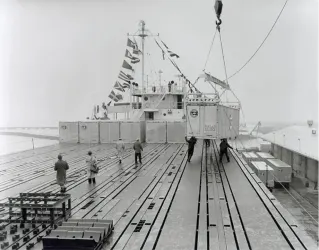
Containers being loaded on the "first container ship", Ideal-X, in 1956 / Source: Maersk/SeaLand
In 1956, the SS Ideal X left port in Newark, NJ and sailed to Houston, TX carrying a load of work trucks in the containers. That year, the average price to manually load a ship was $5.86 per ton. The speed and efficiency of containerization dropped that price to $.16 per ton while also increasing the safety of the product.
By the mid-Sixties, shipping containers were catching on fast, driven in part by the Vietnam War. The US Military took full advantage of this newfound efficiency. Now known as SeaLand Service, McLean successfully lobbied for contracts to build a port in Cam Ranh Bay, Vietnam. In the years that followed, SeaLand would deliver 1,200 containers a month, helping sustain the millions of troops the US would deploy. This major gamble by McLean led to hundreds of millions of dollars spent on container shipping by the military over the course of the war.
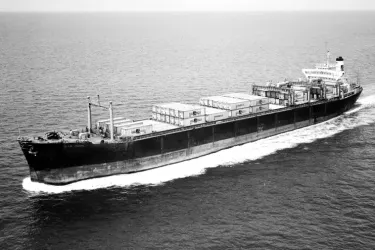
The San Juan, operated by SeaLand / Source: https://www.shipspotting.com/
Already established in the Pacific, SeaLand turned its attention to Japan. In the Sixties, Japan’s economy was growing at a breakneck pace and was the second-largest source of US imports. It was a natural next step and proved to be a successful venture, as China would eventually prove to be as well. But with success comes competition, and the rise of container shipping companies began. As such, SeaLand was eventually acquired by Danish shipping giant Maersk in 1999.
Today, container ships are as long as the Empire State Building is tall and can carry about 20,000 TEUs (Twenty-Foot Equivalent Units). That is a far cry from the 58 containers that set sail to Houston in 1956. This rapid increase in size is depicted in the image below. The smaller ship was built in 2008, and the larger ship behind was built less than a decade later.
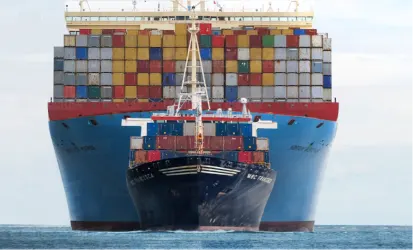
Source: https://www.thefluctus.com/
In the HVACR Industry, most all product from China, Vietnam, Italy, etc. arrives to North America via shipping containers. Ranging from pieces/parts to completed units, the HVACR industry relies on a healthy and long-reaching supply chain supported by shipping containers.
It is quite evident that our industry, and the world for that matter, would look dramatically different if not for shipping containers. In an interesting twist of fate, retired containers are receiving a second lease on life as human residences. Container Homes are being popularized around the globe as cost-effective ways to build elaborate houses and field offices, which ironically, will likely need Heating and Cooling services. The gift that keeps giving.
So, there you have it. The long and short history of the humble shipping container. Now shape up AND ship out.

Brandin Bursa
Supplier Account Manager
Brandin Bursa leads our Associate Member outreach. As an Account Manager, he focuses on active listening and creative thinking to help our members maximize their HARDI membership. By researching & understanding our member's unique needs/situations, Brandin helps to connect members with opportunities to build their business, brand awareness and industry presence.