Advocacy
What HVACR Distributors Need to Know About Outdoor HVAC GFCI Requirements
September 30, 2026 | 5 minute read
Originally published July 15, 2026. This post has been updated to reflect new information.
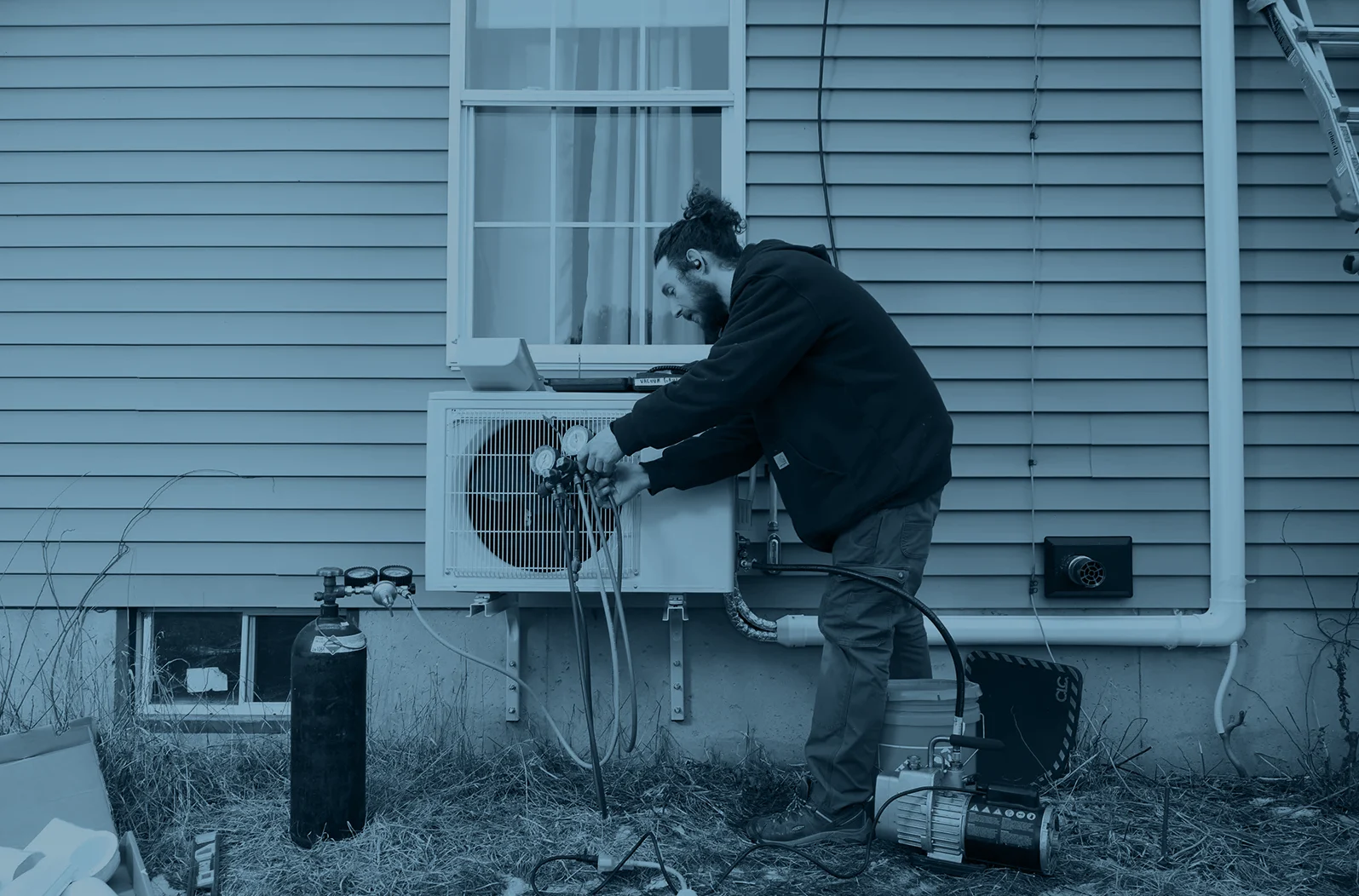
As states continue adopting newer editions of the National Electrical Code (NEC), HVACR distributors should be aware of an important issue that could affect equipment installations, contractor support, and product availability: GFCI protection requirements for outdoor air conditioners and heat pumps.
Why This Matters
Prior to the 2020 NEC, outdoor air conditioning condensers and heat pumps were not required to be protected by ground-fault circuit interrupters (GFCIs).
That changed with the publication of the 2020 NEC, which introduced a requirement for GFCI protection on outdoor HVAC equipment. Soon after the requirement took effect, contractors across the country began reporting widespread nuisance tripping caused by incompatibility between standard GFCI devices and modern HVAC equipment using inverter-driven compressors and other power electronics.
In response, ACCA and AHRI, with support from the National Association of Home Builders (NAHB), appealed the requirement. The National Fire Protection Association (NFPA) ultimately approved a temporary exception, delaying enforcement until September 1, 2026. That exception was also carried into the 2023 and 2026 NEC.
Where Things Stand Today
As part of approving the temporary exception, the electrical industry committed to developing high-frequency (HF) GFCI devices designed to reduce nuisance tripping while maintaining the required level of electrical protection.
However, as the September 1, 2026 expiration date approaches, there remains uncertainty regarding whether these HF GFCI devices are widely available through distribution channels and whether contractors can reliably obtain them for installations.
Meanwhile, the code landscape continues to evolve:
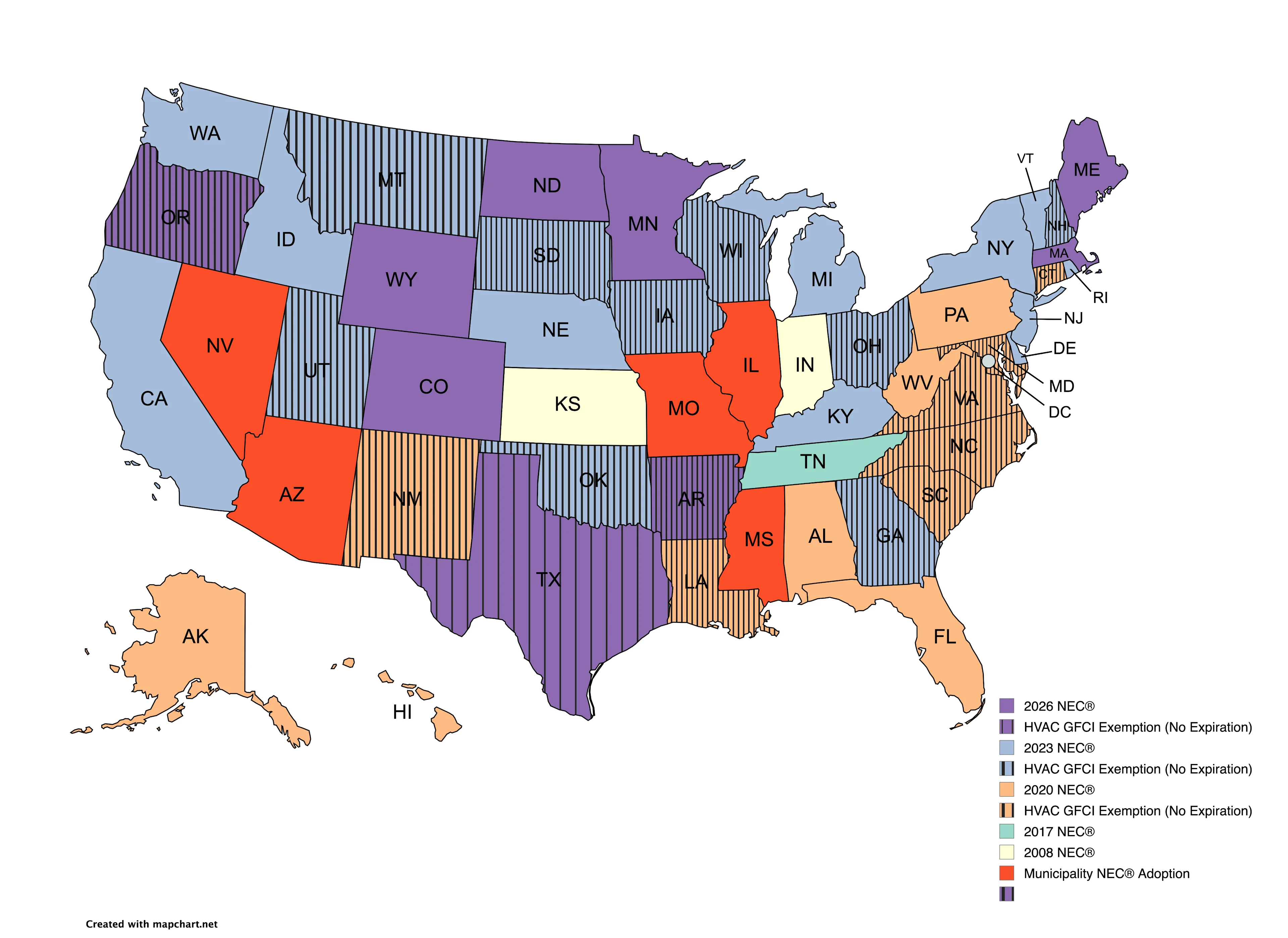
Approximately 40 states have adopted either the 2020 or 2023 NEC, meaning the GFCI requirement will become enforceable when the current exception expires.
Many states have recognized the nuisance tripping issue and have amended their state electrical codes to exempt HVAC equipment or deleted the entire section 210.8(F) completely.
State Adoption Status
As of July 2026, states fall into three categories:
1. States That Have Amended NEC 210.8(F) – Do not require GFCI on outdoor outlets for HVAC equipment
The following states have adopted amendments that delete or modify NEC Section 210.8(F) for outdoor HVAC equipment. Unless these states make future changes, listed outdoor air conditioners and heat pumps will not automatically become subject to the September 1, 2026, expiration of the NEC exception.
Arkansas
Connecticut
Georgia
Iowa
Louisiana
Maryland
New Hampshire
New Mexico
North Carolina
Ohio
Oklahoma
South Carolina
South Dakota
Texas
Utah
Virginia
Oregon
Montana
Wisconsin
(Always verify local amendments before installation.)
2. States with 2017 or Older NEC Effective – Do not require GFCI on outdoor outlets for HVAC equipment currently
The following states have not adopted the newer versions of the NEC that have these specific GFCI provisions. Unless these states make future changes, listed outdoor air conditioners and heat pumps will not automatically become subject to the September 1, 2026, expiration of the NEC exception.
Tennessee
Washington DC
Kansas
Indiana
3. States That Have Not Adopted a Statewide Amendment – Could require GFCI following the upcoming deadline
All other states have adopted the 2020, 2023, or 2026 NEC without amending Section 210.8(F) specific to HVAC equipment.
If no additional action is taken by the state before that date, listed outdoor air conditioners and heat pumps supplied by outdoor outlets covered under NEC 210.8(F) will automatically become subject to the GFCI protection requirements contained in the NEC after September 1, 2026.
What Distributors Should Do Now
Distributors can help contractors prepare by taking a few proactive steps:
Know your state's requirements. Determine which edition of the NEC has been adopted in each state you serve and whether the outdoor HVAC GFCI requirement has been amended.
Talk with your OEM partners. Ask manufacturers which GFCI devices they recommend for their equipment, including any guidance on high-frequency GFCIs intended to minimize nuisance tripping.
Evaluate product availability. Confirm with suppliers whether High Frequency (HF) GFCI devices are commercially available.
Specifically, look for a listed Class A ground fault circuit-interrupter with a high-frequency rating, listed to the Underwriters Laboratory (UL) 943.
Class C Special Purpose GFCIs (SPGFCI), listed to UL943C are permitted as an exception
Prepare your sales and counter teams. Ensure employees understand the applicable code requirements in your market so they can better support contractor customers.
Looking Ahead
The coming months will be important as NFPA considers a potential request to extend the current exception and states continue updating their electrical codes. Regardless of the outcome, distributors should begin evaluating inventory availability, manufacturer guidance, and state adoption status now to ensure they are prepared to support contractors and maintain compliance if GFCI requirements become effective.
Questions?
If you have any questions about outdoor HVAC GFCI requirements, please contact Zac Johnson.
Also, stay up to date on the latest Government Affairs and Advocacy updates by subscribing yourself or your company's key contact for these issues. Get the latest Federal and State issues information impacting the HVACR industry.

Zac Johnson
Senior Policy Lead
Zac Johnson is HARDI’s Senior Policy Lead for Codes & Rebates. He’s responsible for state and local HVACR code adoption and utility rebate programs, analyzing building, mechanical, energy, and fire code proposals that affect equipment installation, compliance, and affordability. Zac brings deep knowledge of the manufacturing industry having managed HVAC product development, test system design, and advocacy efforts on major industry committees shaping codes and standards development.