Advocacy
EPA Releases 2024 Allocation Rule for the Phasedown of HFCs, Marks a Significant Step in the Transition to Low-GWP Refrigerants
October 25, 2022 | 4 minute read

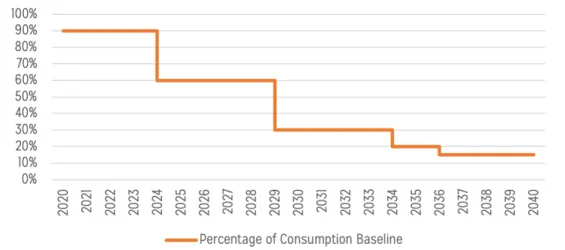
The Environmental Protection Agency (EPA) has released its proposed framework for the production and consumption allocations for 2024-2028. The proposed rule would reduce production and consumption by 40% from the baseline. This is the first significant reduction in allocations as part of the HFC phase-down authorized by the American Innovation and Manufacturing Act (AIM Act).
In addition to establishing the framework for future allocations, the proposed rule also makes minor changes to some reporting and record-keeping requirements for HFC importers and producers. The proposed rule does not change the non-refillable cylinder or QR code tracking requirements included in the previous allocation rule. HARDI’s litigation over these requirements moves to oral arguments with the DC Circuit Court of Appeals on November 18, with an expected decision sometime in 2023.
This proposed rule is the second step in the phase-down authorized by the AIM Act, which will phase down the production and consumption of HFCs by 85% by 2036 with demand reductions assisted by technology transitions to new equipment utilizing lower GWP refrigerants, including a planned change for residential and light commercial air-conditioning equipment in 2025. With the equipment manufacturing transition occurring a year after the significant decrease in the production of HFC refrigerants, it is more important than ever that recovered and reclaimed refrigerants play a role in the phase-down. Below is a worst-case scenario of high-GWP refrigerant demand compared to the phase-down consumption allocations.
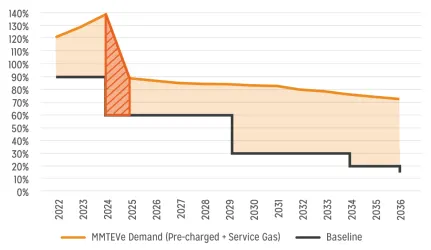
This 80% gap will primarily need to be filled by reclaimed refrigerant and low-GWP refrigerants, where possible. In an effort to increase recovery and the availability of reclaim, the Safe Refrigerant Transition Task Force has put together surveys to learn more about distributor and contractor experiences with recovery and reclaim. Learn more about recovery and reclaim by watching HARDI’s webinar.
Distributors: Please share your experiences with reclaim and recovery to help the industry improve our efforts.
In addition to the use of reclaim, early transitions to low-GWP equipment will lessen the demand for high-GWP refrigerants. Several states have already passed laws and regulations allowing for the installation of equipment using low-GWP A2L equipment, which could become available to distributors before 2025. Below is a map of states that allow A2L equipment to be installed.
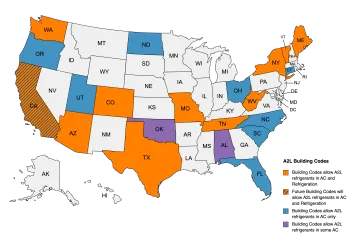
It is up to each manufacturer to begin producing low-GWP equipment; however, state building codes will determine where the equipment can be installed. As more states approve updated safety standards and building codes that allow the installation of A2L equipment, each manufacturer will likely move up the transition dates to ease the demand for high-GWP refrigerants. Several organizations offer training for contractors to install equipment using A2L refrigerants in addition to manufacturer-specific training that will be released with the equipment.
With support from the HVACR industry, HARDI has helped to update model fire codes that determine the storage of flammable gases, including A2Ls, in both pre-charged equipment and cylinders. The 2024 International Fire Code will allow storage of up to 20,000 pounds of refrigerant in cylinders without making any changes to existing warehouses. In warehouses that need to store up to 40,000 pounds of refrigerant in cylinders, appropriate sprinkler density must be in place. For distributors needing to store up to 160,000 pounds of refrigerant in cylinders, additional control spaces made up of fire-rated walls and doors will need to be constructed. The fire code exempts the refrigerant contained in pre-charged equipment from these limits as long as the equipment is designed to the relevant safety standard (as all equipment is). Until states adopt the updated fire code, the amount of refrigerant in cylinders that can be stored will be severely limited, 150 pounds in un-sprinklered warehouses, 300 pounds in sprinklered warehouses, and up to 600 pounds in fire-rated cabinets.

Alex Ayers
Vice President of Government Affairs
Alex is HARDI’s lead lobbyist and regulatory expert, with over a decade of experience in Washington, DC. A former Iowa caucus delegate, he built early roots in grassroots politics. He has lobbied, published, and testified on taxes, energy, environment, agriculture, and economics. His work has been cited by the Wall Street Journal, Forbes, and the Tax Foundation.

You might be interested in...