Tariff Applicability Framework
Bottom line for distributors as of 7/27:
Know your Section 232 exposure first. For most HVACR products, this is the tariff that matters most — both because of its size (up to 50% on covered steel, aluminum, and copper derivatives) and because it now determines whether the new Section 301 forced-labor tariff even applies. Goods already subject to Section 232 are excluded from the new 301 action, so getting your 232 classification right isn't just a cost question — it decides which tariff regime you're in at all.
Check whether your products qualify for the reduced 15% (Sect. 232) rate, and don't assume the relief is permanent. A June 1 proclamation dropped the rate from 25% to 15% for a defined list of residential HVAC equipment and components, effective June 8. Qualification depends entirely on specific HTS codes — two similar products can land on opposite sides of that line — so confirm your classifications rather than assuming coverage, and keep an eye out for updates given the relief's temporary framing.
For anything outside Section 232 — certain components, electronics, or finished goods not included on the derivative list — confirm USMCA-qualifying status is still being properly claimed for Canada/Mexico goods, since that's what keeps those imports exempt from the new Section 301 forced-labor tariff. Also watch CBP guidance on whether the new Section 301 duty stacks with the incoming Section 338 Canada tariffs (effective August 19) — that stacking question is still unresolved and could meaningfully change landed costs on Canadian-sourced goods that fall outside 232.
The sections below walk through the full applicability logic behind this guidance.
Section 122 of the Trade Act of 1974 — the temporary 10% global import surcharge President Trump imposed in February following the Supreme Court's ruling that IEEPA does not authorize broad-based tariffs — expired by statutory limit at 12:01 a.m. on July 24, 2026. Congress did not act to extend it.
In its place, the U.S. Trade Representative finalized new Section 301 tariffs on 60 trading economies following investigations into forced-labor enforcement practices. These new duties apply a 10% rate to economies USTR found have adopted, or committed to adopt, an effective forced-labor import prohibition, and a 12.5% rate to economies that have not — a group that includes China, the EU, Japan, and most other major trading partners. A narrow in-transit exception applies to goods already loaded for shipment before July 24, provided they are entered for consumption before July 28, 2026.
As shown in the figure below, U.S. HVACR equipment is primarily supplied by domestic manufacturing, supplemented by imports — most notably from Mexico, China, and Canada.
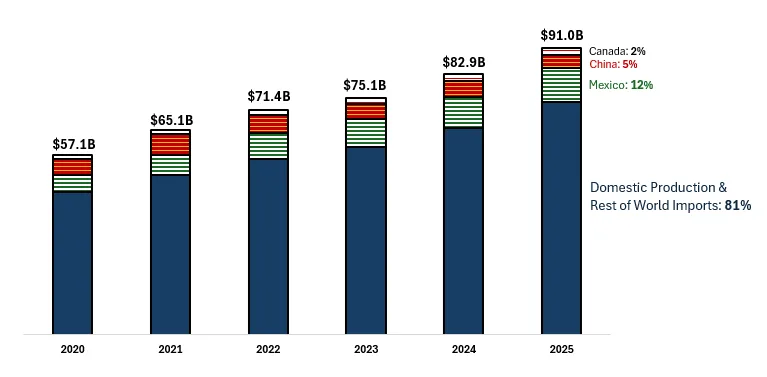
Source: U.S. Census Bureau, U.S. International Trade Commission, HARDI estimates
At the same time, existing trade measures — including Section 232 (steel, aluminum, and copper) and the original China-specific Section 301 tariffs — remain in place. Because these authorities operate independently, products may be subject to more than one tariff program simultaneously.
The framework below outlines how Section 232, the new Section 301 forced-labor tariffs, and the original Section 301 China tariffs interact for purposes of determining potential duty exposure. This overview is intended for general informational purposes and reflects current CBP implementation guidance, which continues to evolve.
1. Section 232 Applicability
If the product's HTS classification is covered by Section 232:
The applicable duty (currently 50% for covered steel, aluminum, and certain copper articles and derivatives) applies to the dutiable base specified under that program.
For many derivative products, this means the duty applies to the declared value of the covered metal content.
In cases where the entire article is covered by Section 232 — or where required metal content value cannot be substantiated — the duty may apply to the item's full value.
Important: Articles subject to Section 232 are excluded from the new Section 301 forced-labor tariffs, per USTR's July 23 fact sheet.
3. Section 301 Forced-Labor Applicability
Is the country of origin one of the 60 economies named in USTR's July 23, 2026 determination, and is the product not otherwise exempt?
A 10% duty applies to economies USTR found have imposed, or committed to impose and enforce, a forced-labor import prohibition (a group that includes Canada and Mexico, among others).
A 12.5% duty applies to the remaining economies found not to meet that standard — including China.
Exemptions include: articles already subject to Section 232; civil aircraft, engines, parts, and components; pharmaceutical articles and precursors (with patented pharmaceuticals added effective July 31, 2026); certain raw materials and products not available in sufficient quantity domestically; informational materials, donations, and accompanied baggage; and qualifying goods loaded in transit before July 24, 2026 (if entered for consumption before July 28, 2026).
Note: CBP has not yet clarified whether these tariffs stack with the Section 338 tariffs on Canadian goods scheduled to take effect August 19, 2026. Members should monitor CBP guidance closely on this point.
2. USMCA Qualification (Canada and Mexico)
Is the product imported from Canada or Mexico and properly claimed as USMCA-compliant?
If an item qualifies as an originating good under USMCA rules of origin and is properly claimed by the importer, it is exempt from the new Section 301 forced-labor tariff (HTSUS 9903.05.93 for Canada, 9903.05.94 for Mexico).
If the item does not qualify under USMCA rules, the portion of the product not covered by Section 232 is subject to Section 301 forced-labor duty described below.
Note: With Section 122 now expired, USMCA's tariff-exemption role has shifted to the new Section 301 forced-labor tariffs. Members should confirm current CBP treatment of USMCA-qualifying goods, as guidance is still developing.
4. Original Section 301 Exposure (China-Specific)
Is the country of origin China, and is the HTS code covered under the pre-existing, China-specific Section 301 tariffs (Lists 1–4)?
If both conditions apply:
The applicable original Section 301 tariff rate applies in addition to any Section 232 duties and the new Section 301 forced-labor duty described above, unless a product-specific exclusion applies.
Litigation and Policy Risk
The new Section 301 forced-labor tariffs are already being challenged. On July 24, 2026, plaintiffs (including a party involved in earlier Section 122 litigation) filed suit at the U.S. Court of International Trade arguing USTR's action exceeded Section 301's country-specific findings and remedial requirements. Section 301 has a much stronger legal track record than IEEPA or Section 122. Notably, the Supreme Court recently declined to review an appellate decision upholding existing Section 301 tariffs on China, but members should expect continued legal and regulatory activity in this area.






Tariff Toolkit
The HARDI Tariff Toolkit introduces the fundamentals of tariffs and their role in international trade, including the World Customs Organization's Harmonized System for classifying goods. This course provides our distributor members with guidance on reading the Harmonized Tariff Schedule (HTS) and offers specific tariff information relevant to the HVACR distribution industry, ensuring participants stay informed as trade regulations evolve.