Products & Services
The Difference Between Bottlenecks and Scalable Growth: Order Automation
March 12, 2026 | 4 minute read
Picture your branch counter on a busy morning.
Phones are ringing. Customers are lined up. Two handwritten lists come in via text from unsaved numbers. An email quote needs updating. Someone in the warehouse shouts a stock question. Another customer wants an update on yesterday’s order.
Your team isn’t slacking. They’re sprinting.
But despite the effort, orders slip through the cracks. Follow-ups get delayed. Quotes stall. Customers wait longer than they should.
That’s the difference between a bottlenecked branch and a scalable one.
Bottlenecks Aren’t About Effort — They’re About Workflow
For decades, distribution has relied on hustle. Reps juggle calls, emails, texts, faxes, and counter conversations all at once. Orders start in one place, get re-keyed into another, and live somewhere else for follow-up.
It’s not a people problem. It’s a systems problem.
When orders are handled manually across disconnected channels:
Reps re-enter the same information multiple times
Updates live in inboxes or in someone’s memory
Managers lack visibility into open quotes and order volume
Follow-ups depend on who remembers what
The cost adds up quickly:
Slower response times
More errors from manual entry
Missed revenue from dropped or delayed follow-ups
Burnout from constant firefighting
Teams stay stuck reacting instead of driving growth.
What Scalable Growth Actually Looks Like
With order automation in place, teams don’t just work faster — they work smarter.
Inbound messages from phone, email, text, and web chat flow into one system. Orders follow standardized workflows instead of ad hoc processes. Quotes are visible. Follow-ups are tracked. Managers see real-time activity.
The shift is subtle but powerful:
Reps spend less time chasing details
Customers get faster acknowledgments and clearer updates
Branches unlock capacity to handle more orders without adding headcount
Instead of clearing the queue all day, reps gain time to recommend add-ons, follow up on open quotes, and re-engage quiet accounts.
That’s when automation stops being an operational tool and becomes a growth engine.
AI Isn’t Replacing Reps — It’s Removing Friction
There’s a lot of noise around AI. In distribution, it’s far more practical than the headlines suggest.
AI-powered order automation acts as a sidekick — not a replacement.
It helps by:
Classifying incoming messages (order, quote, service request, urgent)
Suggesting SKUs based on descriptions, photos, or order history
Drafting responses reps can approve or edit
Summarizing conversations so no one has to dig through threads
The rep stays in control. AI handles the repetitive steps.
The immediate benefits show up quickly:
Time saved per interaction
Fewer omissions and keying errors
Reduced burnout
More bandwidth for complex customer needs
When reps aren’t buried in manual work, they use their expertise where it matters most: advising customers and driving orders.
Speed Is the New Competitive Advantage
In today’s market, speed isn’t just operational — it’s strategic.
Customers expect:
Fast acknowledgments
Clear order status updates
Mobile ordering that doesn’t interrupt their day
When your branch responds first and follows up consistently, you reduce uncertainty and prevent customers from shopping around.
Often, the first clear response wins the order.
Order automation makes that speed repeatable.
From Fragmented Tools to a True Order Engine
Many distributors have taken early steps — shared inboxes, basic routing rules, templates, and snippets.
That’s a start.
But scalable growth happens when workflows connect end to end:
Intake flows directly into quote creation
Quotes convert seamlessly into orders
Status updates trigger automatically
Reporting surfaces response time, order volume, and follow-up gaps
The industry is moving from patchwork tools to fully connected order engines — systems that capture, move, and grow orders with less friction.
And what’s next goes even further:
Context-aware automation that recognizes repeat jobs
Suggested kits and accessories based on history
Predictive insights that flag upsell opportunities
Alerts when customers slow down ordering
The result? Branches move from reactive service to proactive selling.
Crawl, Walk, Run: Building Toward Scalable Growth
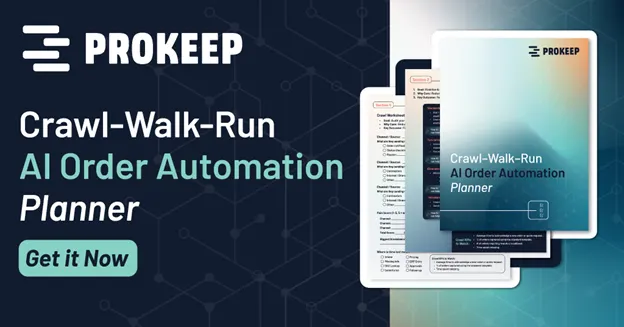
Prokeep’s latest guide, the Crawl-Walk-Run AI Order Automation Planner breaks down how leading distributors are implementing Order Automation without any heavy lifting and using it to drive more orders.
This guide covers:
Why fragmented order workflows slow teams down and cost real revenue
The hidden operational cost of manual intake, rework, and follow-up gaps
A phased framework for introducing order automation without disrupting teams
How AI-powered workflows help distributors move from reactive service to proactive selling
Prokeep is proud to help HARDI distributors modernize how orders are captured, processed, and fulfilled—building a foundation for scalable, order-driven growth.
Download the guide to learn how order automation turns inbound demand into faster service, fewer errors, and more orders.
Prokeep

You might be interested in...

Products & Services
Webinar Replay: How Distributors Can Drive More Equipment Sales—Without More Leads

Products & Services
When Your Kids Don’t Want It: Creative Succession Plans That Don’t Involve a ‘For Sale’ Sign

Products & Services