Market Intelligence
Potential for Office Retrofits for Commercial HVAC Demand
March 20, 2024 | 5 minute read

Office space has historically composed a large section of nonresidential repair and replace HVAC demand in the U.S., but over the last few years we’ve seen a steady decline in this segment of the commercial real estate market. Large scale use of office space is historically propped up by two factors; many workers occupying these spaces and freely available loans to build and buy these buildings. Since 2020, there has been increasing pressure on both leading to the challenging office space market we have today.
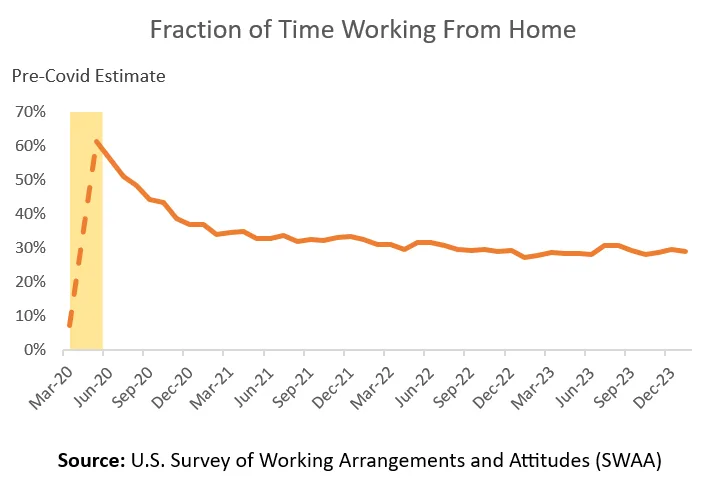
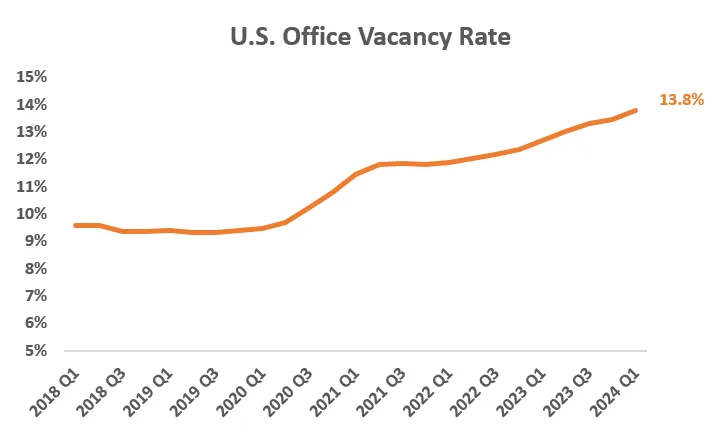
The chart above depicts the fraction of time spent working from home as collected by the U.S. Survey of Working Arrangements and Attitudes (SWAA). Pre-Covid, this fraction was estimated to be around 7 percent and over the last few years has remained at a steady 30-40 percent. At the same time, 42 percent of workers are either fully remote or hybrid and the average worker desires 2 to 3 work-from-home days per week now (SWAA). U.S. workers are increasingly enjoying the ability to work outside of the office and as a result office vacancy rates have risen as shown in the chart below.
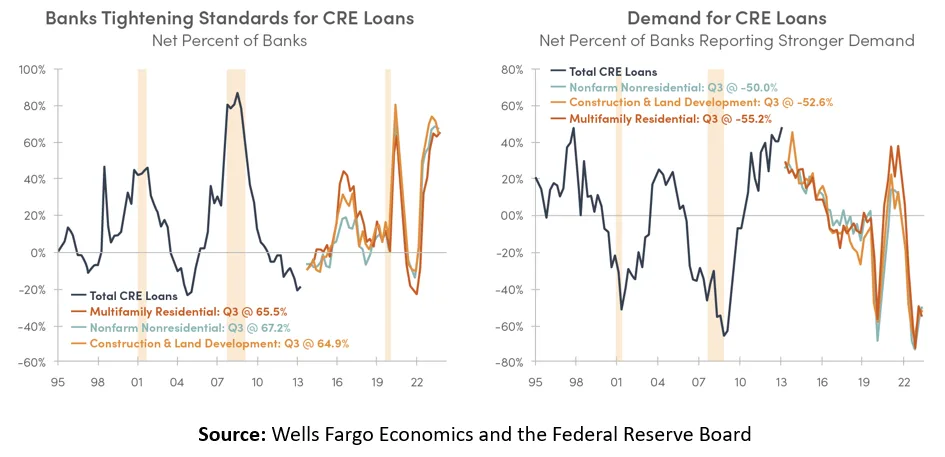
At the same time, commercial real estate loans have become more expensive and harder to access. The two charts below represent current commercial real estate (CRE) lending standards and demand for CRE loans. The chart on the left shows that approximately 65 to 70 percent of domestic banks are reporting tightening lending standards and the chart on the right shows that among all types of CRE loans there is approximately 55 percent less demand for those loans that are available.
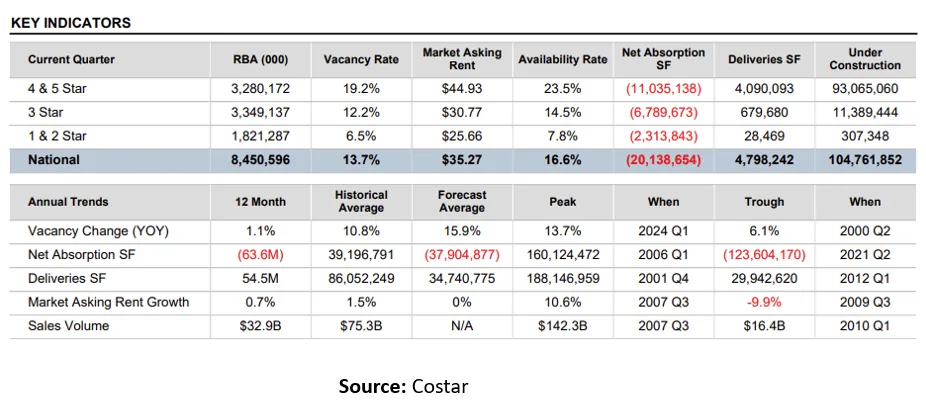
Economic conditions and the aftermath of the pandemic on work culture have combined to form a dim outlook for office space. The table below shows several key indicators as of 2023Q4 for the Office space market. Net Absorption, a measure of existing square footage occupied less square footage vacated ended at -64 million square feet marking four straight years of decline and contributing to a vacancy rate of nearly 14 percent.
Conversion and Retrofit activity offer an upside potential over the next several years.
Amongst a stable work-from-home trend and tough lending standards, the office market in coming years will be dominated by building retrofits and conversions. While sometimes used synonymously the two terms mean different things: a retrofit involves improvements to the office space whereas a conversion means the structure will be used for some other purpose. Both options can prove to be valuable sources of revenue for HVAC as in either case an overhaul of the plumbing, electrical, and HVAC systems are involved.
Office space typically is classified as either Class A, B or C. Class A buildings represent premium, top-of-the-line buildings in highly desirable business centers; Class B are either past-their-prime Class A, or more affordable but still well-managed office space; and Class C is the cheapest and is usually lacking in amenities and location. Of the three classifications, A tends to feel the impacts of an economic slowdown first due to the higher rents but is also the quickest to recover. As a result, management companies may consider Class B retrofits in select markets to push these buildings into a higher echelon and capture the expanded market interest in upper-tier properties. Class C properties, however, are typically not good candidates for upmarket renovations due to the risk and overhaul involved. Instead, Class C buildings offer more opportunities for conversion, especially to Multifamily.
Many large cities in the US have started policies and large-scale projects with the hopes of converting dead office space into new multifamily properties to solve both affordable housing concerns as well as freeing up stagnant properties. However, a key issue blocking many of these conversions is the building layout itself. Many Class A and B office spaces have floorplans and infrastructure that are poorly suited for residential conversion. Either poor or odd lighting, high ceilings, and awkward building layouts can all halt a residential conversion, but Class C space provides elegant solutions to many of these. In a 2020 article written by Gensler, an architectural firm, they cited several weaknesses of Class C space that can be valuable when converted:
Lease spans of 25 to 35 feet are perfect for smaller residential units. Allow a 600-square-foot unit to be 20 feet wide with a corridor behind.
Floor-to-floor heights for Class C offices go as low as 11 feet, but that is much higher than the 9 feet, 6 inches, which is currently targeted for new residential developments.
Small floor plates — around 8,000–10,000 square feet — are generally very desirable and can be easily subdivided into a good mix of residential units.
Offices require more elevators and servicing than residential. This generally means that one of the existing elevators can be converted to a riser or garbage chute.
Taller buildings with split elevator banks can make for an excellent mixed-use building. Splitting residential and commercial across the low rise and high-rise banks provides great flexibility.
Many very large cities are starting to take interest in a concerted push for office-to-multifamily conversion such as the NYC Office Conversion Accelerator. Conversions in these larger cities could offer large ticket opportunities for HVAC distributors as these conversions are often focused on luxury apartments as a way to justify the cost and risk according to a recent 60 Minutes segment.
With the bleak outlook in the office space market going into 2024 and beyond, distributors should be aware of the potential for conversion and retrofit opportunities that arise and should be prepared to take advantage of them especially in large urban hubs where conversions are most likely to gain traction.
HARDI's 2023-24 State of the Channel Report
For a comprehensive analysis of the current and future state of the HVACR industry, purchase HARDI's 2023-24 State of the Channel (SoC) report. This report provides members with detailed insights into the growing threats facing wholesale distribution and the opportunities for gaining market share.

Tyler Drown
Former Quantitative Research Analyst at HARDI
Tyler previously served as an analyst on the Market Intelligence team, where he used his background in economics and statistics to deliver content on market insights that helped members make informed, data-driven decisions.