Market Intelligence
Navigating the Future of Work: Remote, Hybrid, or In Person?
March 5, 2024 | 5 minute read

The Current Landscape
Since Covid disrupted the conventional work environment, a recurring topic surfaces occasionally: the prospect of returning to in-person work and moving away from remote work. This raises questions — Are workers going back into the office? Are work environments really returning to the way they were before the pandemic? Now that several years have passed since the peak of the Covid disruption, data shows what’s happened and where things could be going. More workers staying at home could incentivize spending on updating HVAC systems to keep them comfortable.
Work From Home Trends
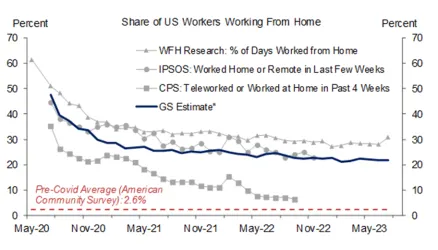
During the worst of the pandemic, about 47 percent of jobs worked from home at some point each week. Since then, things have cooled off. Now, 20-25 percent of workers incorporate remote work into their weekly schedules. A transition has taken place, but remote work still significantly surpasses pre-pandemic levels, where only 2.6 percent of workers engaged in some form of remote work. Below, Goldman Sachs illustrates these trends. Additionally, a survey from WFH Research, a research group studying working from home, noted that those who can work from home spend about 30 percent of their week at home, or 1.5 days a week.
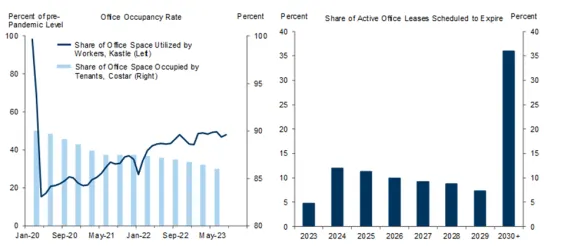
The dark blue line graph below illustrates office building access swipes across 10 major US cities. Based on this metric, pre-Covid office utilization has recovered by about 50 percent. Utilization is down, but based on data from CoStar, occupancy rates have only dipped 4 percent since Covid. Goldman Sachs estimates that a 1 percent increase in office vacancies equates to a $10.8 billion decline in fixed investments for office structures. The effects of low utilization haven’t translated to vacancies yet, as many companies' leases are still in effect. More than 35 percent of leases will expire after 2030. With such long leases in place, it's tough for businesses to adjust quickly to lessen office space needs caused by increasing remote and hybrid work.
New job postings are aligning with the remote work trend. According to WFH Research, over 10 percent of job postings are remote. They say this percentage continues to grow, but LinkedIn disagrees. LinkedIn reports that fully remote postings have instead decreased each year, but still account for 10 percent of postings (13 percent hybrid). Interestingly, fully remote positions receive 46 percent of all job applications on Linkedin. This is a 2 percent decrease from 2022. The demand for remote positions remains very strong while remote and hybrid positions make up 26 percent of LinkedIn postings.
Hybrid work has been the solution for many employers and employees who don’t want to commit to either work style. According to WFH Research’s most recent survey, 46.8 percent of respondents were hybrid, 33.6 percent were fully on site, and 19.6 percent were fully remote. As employers dial back from remote working, hybrid has become the new normal. Recent research also indicates that employers pushing a full-scale return to the office risk fracturing employee morale. The University of Pittsburgh found that companies issuing a full return to office memorandum experienced no financial improvement and had a 99 percent drop in employee job satisfaction. Pitt researchers studied over 130 S&P 500 firms from 2019 to 2023.
Future Outlook and HVACR Impact
The topic of remote work will be debated for years to come. Sure, there will be plenty of employers that require work in person, but the overwhelming demand for remote work, whether hybrid or fully remote is undeniable. Workers 29 and under had the most demand for remote/hybrid work. They’ve gone to school and started their careers online. For many of them, it's what they’re accustomed to. It’s not just the younger generation who value remote and hybrid work though. A Stanford University Professor’s survey of over 100K workers determined that people value working from home 2-3 days a week as much as receiving an 8 percent pay increase.
HARDI members should be aware of shifting workplace settings. Those who work from home will be using their furnace and AC more than if they worked at an office. Like with Covid, the more time people spend at home the more aware of their system's performance they’ll be.
Using data from WFH Research and the Department of Energy (DOE), HARDI has estimated the number of households that would have increased furnace and AC use due to remote work. WFH Research noted that higher-income individuals ($100K+) are more likely to work from home and own a home, with nearly 60 percent working remotely at some point during the week. HARDI's analysis of DOE survey data revealed that higher-income households are more inclined to use smart thermostats for automated temperature regulation based on occupancy. Higher-income households had the largest difference in home temperature depending on presence. This confirms that households earning $100K+ will increase furnace and AC use working from home, impacting nearly 20 million households. If remote work continues to rise, for all incomes, this trend will further elevate HVAC usage and demand.
While there has been a partial return to in-person work, the shift towards remote and hybrid work appears to be a lasting trend, driven by both employee preferences and the practical considerations of companies adapting to changing workplace dynamics.
HARDI's 2023-24 State of the Channel Report
For a comprehensive analysis of the current and future state of the HVACR industry, purchase HARDI's 2023-24 State of the Channel (SoC) report. This report provides members with detailed insights into the growing threats facing wholesale distribution and the opportunities for gaining market share.

Jake Miller
Research Analyst
As a Research Analyst on HARDI's Market Intelligence team, Jake leverages his education in finance and real estate from the University of Cincinnati to provide industry insights and benchmarking programs for HARDI membership. He has a strong foundation in analysis and statistical methods, which he utilizes through in-depth research work to develop membership insights.