Market Intelligence
Cooling Off: A Review of 2023 Year-End Contractor Activity
February 21, 2024 | 4 minute read

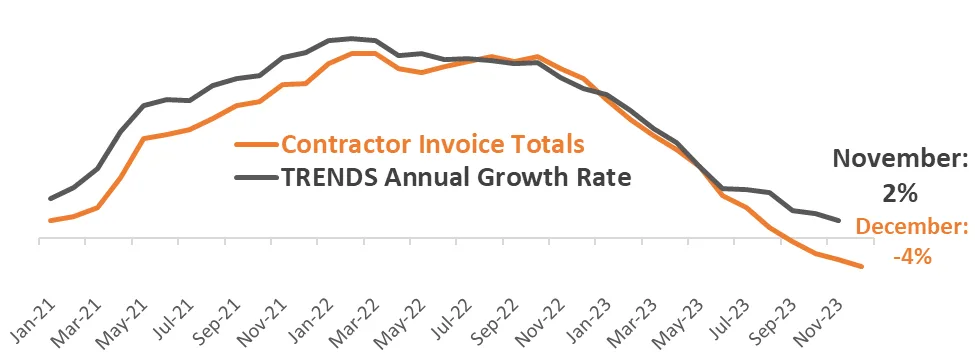
The theme dominating the industry this year is that of normalization and its effects have been seen all the way from OEM’s down to the contractor level. Wholesale demand is primarily generated from the bottom up, starting with the needs of the end user and through the contractor they hire. For the last half-year, we have increasingly relied on data provided by Field Edge to better understand performance in contractor activity and the effects it has on wholesale demand. The plot below may look familiar to frequent readers of HARDInomics. Starting in November we began including commentary comparing the year-over-year growth in contractor invoice totals to that of Trends annual growth rate. What we’ve seen is that the two figures follow each other very closely with our Field Edge data acting as a leading indicator for Trends.
Demand shifts from replace as residential housing slow.
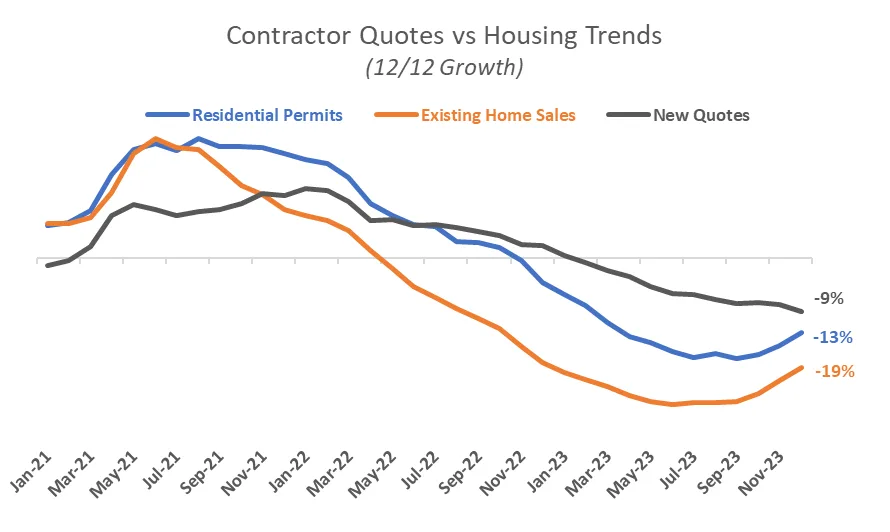
Field Edge provides us with several measures of contractor activity. One of those measures, new quotes, provides an excellent proxy for replacement activity. It’s our understanding that quotes, as opposed to invoicing, primarily captures very large repair jobs or the installation of a new unit either via replacement, add-on, or for a new construction job. The data below shows the annual growth on a 12-month rolling average basis for new quotes issued by contractors in the dark line below. Quoting activity has decreased steadily over the year starting at 0 percent in January and finishing 2023 at -9%. Over the same period, growth in new residential permits (depicted in blue) as well as housing resales (orange) have also steadily decreased indicating weakening replacement demand through 2023 and into 2024.
Source: FieldEdge, U.S. Census Bureau, National Association of Realtors
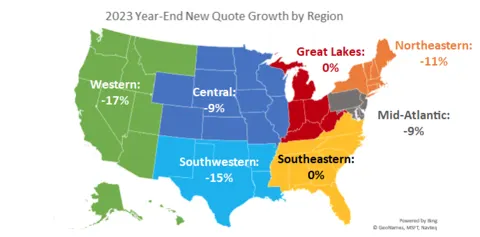
Source: FieldEdge; Note: WV, DC, AK, and HI are excluded from their regions due to outlier correction.
Across most HARDI regions, year-end growth in New Quotes is down high-single digits to double-digits from 2022 totals. Only the Great Lakes and Southeast escape this trend with 0 percent growth. In the Great Lakes in particular, easy weather comps going into heating season for 2024 will likely provide a strong tailwind for this region. Otherwise, until the housing market begins to turn, we at HARDI expect these trends to continue.
Repair takes the spotlight amongst a slowing economy and increasing costs.
Source: FieldEdge
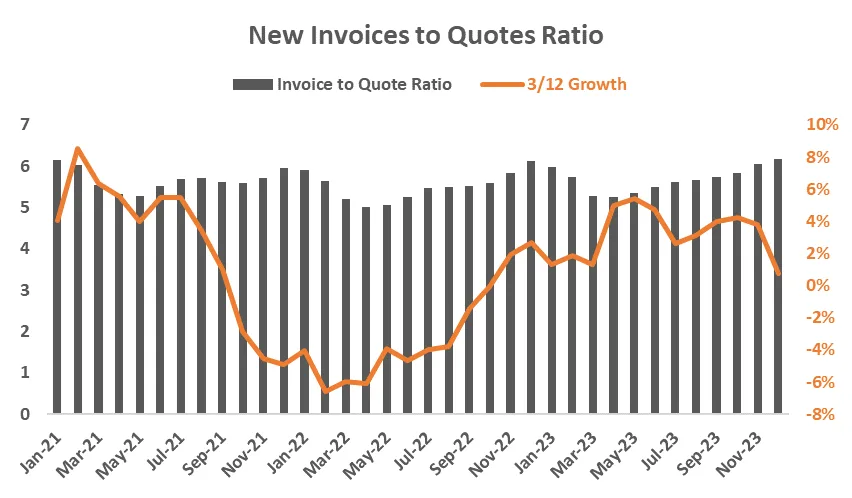
The chart above depicts the ratio of New Invoices to New Quotes on a 3-month rolling average. Increases in this ratio indicate an increased preference for repair activity as opposed to replacement. With inflated home prices and high mortgage rates, there is a lot of pressure against the inflated replacement demand of a few years ago. Combining this with a slowing economy and rising unit prices, HARDI expects repair work to continue to outshine replacement through at least the first half of 2024. We have also heard reports from members and contractors stating that the originally imposed Technology Transition Rule, slowed buying activity, and in some circumstances, end-user purchasing. Some contractors and homeowners were opting more into repair in the fears that pushing and buying an old system might become obsolete or more expensive once the new technology became available. The recent decision to extend the sell through date to January 1, 2026, likely changes this and we hope to see this confirmed by AHRI shipment data for Q1 2024.
Fortunately, despite lingering macroeconomic headwinds, 2024 is shaping up to be a more normal year for wholesale distribution, and the HVAC/R market as a whole. While a depressed housing market has dampened replacement demand, the growing costs of equipment and installations are helping to protect contractor and distributor revenues in the short run. In the longer run, a sluggish 2023 housing market means easy 2024 comps, even if mortgage rates remain north of 6.5 percent.
For readers looking to gain a more complete understanding of the HVAC/R distribution landscape for the year to come, consider purchasing our State of the Channel report, which is slated for release later this month.
HARDI's 2023-24 State of the Channel Report
For a comprehensive analysis of the current and future state of the HVACR industry, purchase HARDI's 2023-24 State of the Channel (SoC) report. This report provides members with detailed insights into the growing threats facing wholesale distribution and the opportunities for gaining market share.

Tyler Drown
Former Quantitative Research Analyst at HARDI
Tyler previously served as an analyst on the Market Intelligence team, where he used his background in economics and statistics to deliver content on market insights that helped members make informed, data-driven decisions.