Market Intelligence
An Office is a Place Where Dreams Come True: 2023 Office Market Outlook
June 22, 2023 | 6 minute read
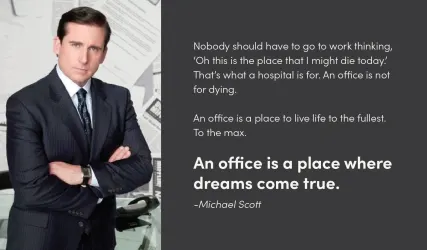
In his role as Michael Scott in The Office, Steve Carell’s comments (like those in the image on above) regularly showcases the centrality of the office to the lives of workers across the U.S. And yet, despite the office’s importance to our lives pre-Covid, demand for office real estate post-Covid remains a far cry from its early-2020 level. Net absorption, or the net change in square footage occupied during a given period, was down 2.3 million square feet at the end of 2022 from Q4 2021 levels.
Nationally, HARDI expects demand for commercial office space to further soften over the course of 2023. However, the ultimate performance of office properties through the remainder of 2023 will vary by region.
Regional Office Markets
The HARDI regions with large office markets are the Southeast (with 166,000 buildings with 2.1 billion square feet), Northeast (with almost 72,000 buildings with 1.9 billion square feet), and Central (with 83,000 office buildings with 1.8 billion square feet). Office demand in these areas are all expected to take larger hits due to low demand. These markets have also been slower to rebound compared to smaller markets, making them more susceptible to a correction in overall commercial office prices.
The Southwest region comes slightly below the Central region (with 87,000 buildings and over 1.5 billion square feet). The Mid-Atlantic and Great Lakes regions have smaller shares of the overall US office market (Mid-Atlantic with a little over 91,000 buildings with over 1.9 billion square feet and Great Lakes with almost 81,000 buildings and a little over 1.2 billion square feet). The West has the smallest share of the US office market. This region has approximately 13,000 buildings with a considerably smaller amount of square feet (206 million square feet).
Regional Differences
We pulled data from CoStar’s forecasting scenarios to better understand regional trends over the next several years. CoStar is an international provider of commercial real estate data and analytics used by some of the biggest names in the industry. CoStar provides data on over 6.4 million properties worldwide and are one of the best sources of commercial real estate data available.
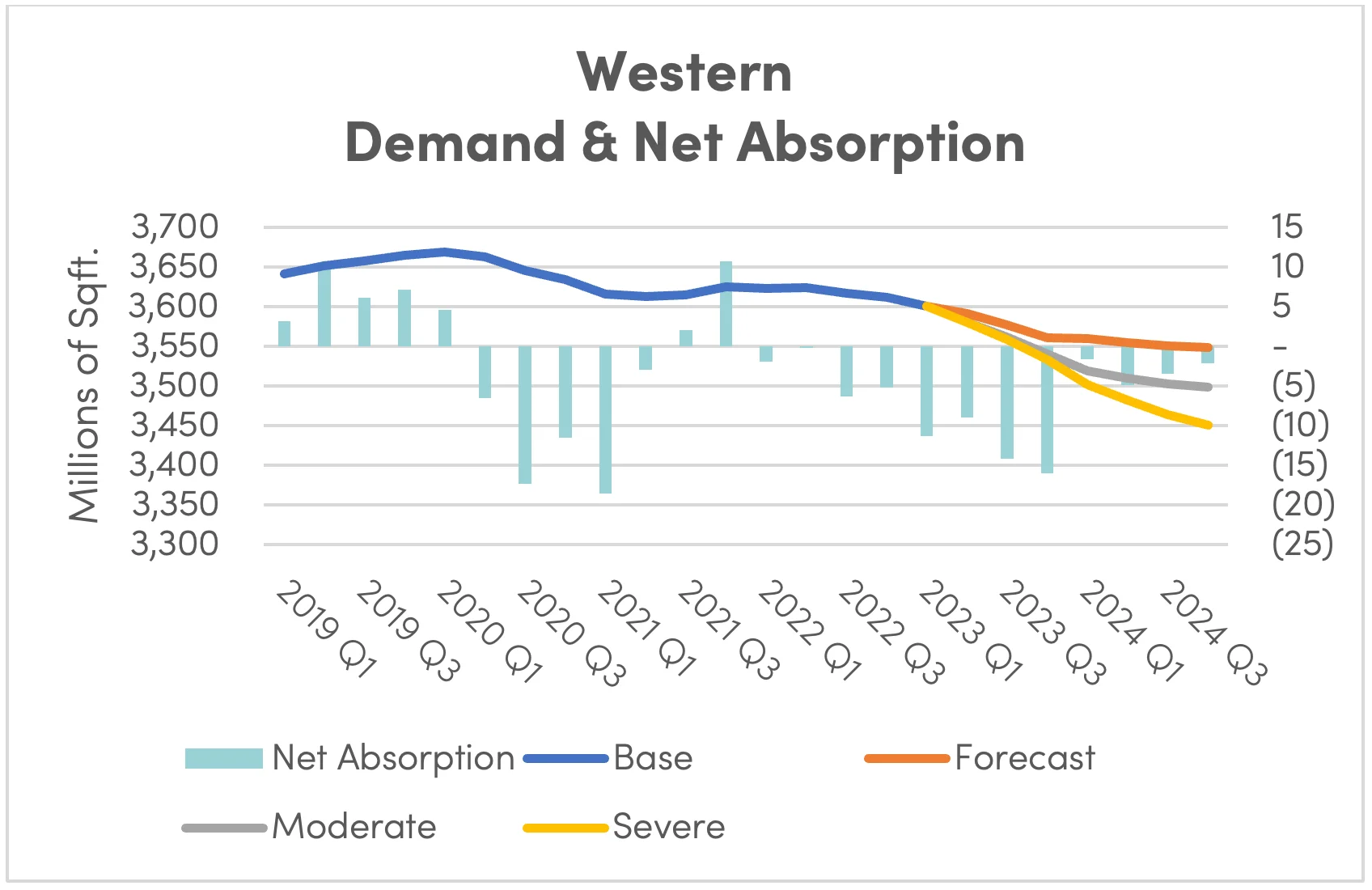
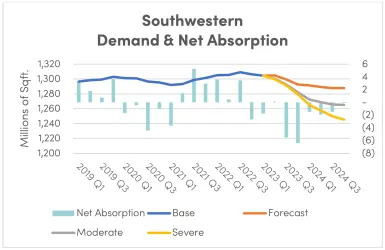
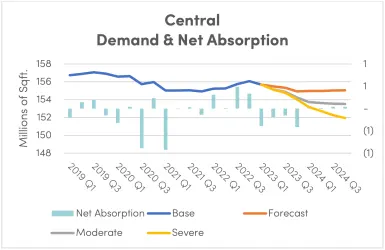
The visuals show three scenarios: Base Case, Moderate Economic Downturn, and Severe Economic Downturn. These scenarios are forecasted using inputs provided by Oxford Economics’ metro region outlooks published Q1 2023 and consider changes to employment growth, interest rates, and risk spread. The Base Case Scenario has a minor economic slowdown built in. It should be noted that CoStar forecasts capture CoStar’s market locations, meaning that these markets are a representative sample of their area. However, they do not account for ALL properties by geographic area. As HARDI predicted, the demand for office space experienced a downward trend from the start of the pandemic to 2022. We expect this trend to continue.
Western Region
The Western office market decreased after the start of the pandemic in early 2021. Demand rose slightly in 2022. However, the Western market trend is expected to continue downward and at lower levels of total square footage compared to pre (2019) and during (2020) pandemic levels (as shown in all scenarios: base, moderate, and severe).
Southwestern Region
HARDI observed a surprising increase in office square footage demand after the initial pandemic shock in the Southwestern region. This trend is unlikely to continue as the economy shows signs of slowing through 2024 with minor decreases at best and historic lows in the worst-case scenario.
Central Region
Demand for office space in Central states is typically lower in general when compared to other regions and so while there is downward pressure on demand in the coming years, the effect should be relatively minor.
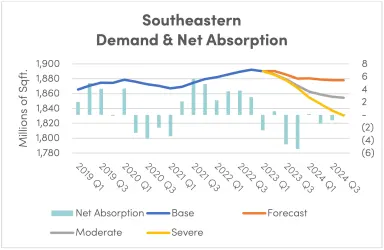
Southeastern Region
The Southeastern region shows one of the stronger outlooks into 2023-24 with only a sharp decrease in net absorption during late 2023 followed by a more moderate slowdown through 2024.
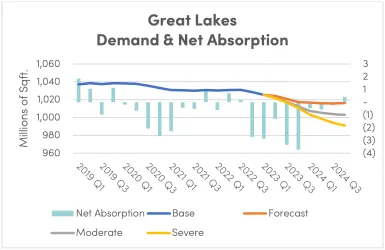
Great Lakes Region
Office space demand in the Great Lakes region has been steadily declining over the last four years and this trend will continue into 2023. Late 2024 could potentially see some recovery as demand begins to trickle back upwards.
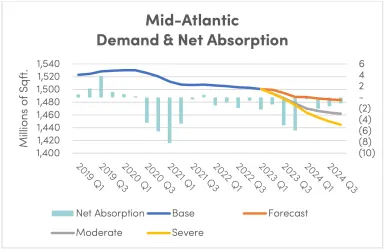
Mid-Atlantic Region
Mid-Atlantic states follow the Great Lakes outlook closes with a steady, but moderate decrease in demand through 2024.
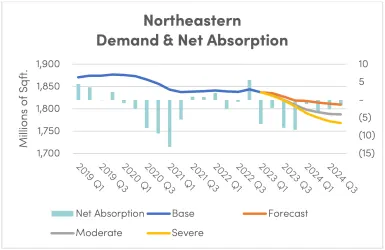
Northeastern Region
The outlook for office space demand in the Northeastern region is somewhat bleak. Demand has seen a sharp decline through the pandemic with signs of this pattern continuing through the next several years. Unlike other regions, it seems unlikely that there will be much recovery in this market until 2025 or later.
HARDI Regions Compared to the U.S.
Overall, most HARDI regions follow the same trend as the aggregate U.S. Demand for office space (square footage) has been declining as a result of the pandemic and remote work shocks and further compounded by the current and upcoming economic conditions. Some geographic locations are placing return to office mandates while other cities such as Miami and Nashville are experiencing population growth along with more supply constraints which equips them to handle a correction in total commercial valuations. Despite these factors, which may cushion demand in smaller markets, it will do little to move the needle for the office market as a whole.
Implications
The regional differences highlighted in this post show that office demand is not equally divided among regions. Most regions are in line with overall aggregate U.S., however, the rates at which office demand is declining varies. First, distributors should take a closer look at commercial office real estate trends in their local areas. This blog post is limited in that it provides data from a regional outlook. Second, small to mid-size markets along with different building classes may experience higher spikes in demand because of land and pricing. Due to population growth in these cities, HARDI expects an increase in HVAC/R maintenance and repair activity. New construction is more likely to increase in these markets compared to those in larger cities. When it comes to new construction, property managers and their engineering teams are more often than not to purchase energy efficient equipment due to the significant amount of future savings. Distributors should also educate themselves on their location’s energy efficiency rebates and incentives to best stock inventory.
Another trend which may have a small effect is the push to upgrade and create smart high-tech buildings to better attract and retain workers. Distributors serving these markets should be prepared to stock appropriate HVAC/R equipment for these smart buildings. Smart commercial buildings tend to use more electricity. Therefore, we expect a small increase in demand for energy efficient equipment such as chillers, CRAC, and CRAH units. However, all distributors should analyze their inventories and adjust accordingly. Furthermore, distributors should consider serving other segments such as retail, education, and industrial spaces to help lighten the impact of lower commercial office demand.

Keri Eason
Nonresidential Market Analyst

Tyler Drown
Former Quantitative Research Analyst at HARDI
Tyler previously served as an analyst on the Market Intelligence team, where he used his background in economics and statistics to deliver content on market insights that helped members make informed, data-driven decisions.