HR & Training
Microlearning: A Research Backed Method to Increase Knowledge Retention in Less Time
June 18, 2024 | 5 minute read

In today’s fast-paced and over-stimulated world, it is increasingly difficult to grab attention, and even more difficult to keep that attention. One thing that has not changed, however, is the need for workplace education. In the HVACR industry, it could be a full-time job just keeping up with new regulations and compliance changes. It seems like whatever we learned yesterday was replaced by a new amendment or permit today. The problem is there is a lot to learn, with little time to learn it.
What if I told you that you could take an e-learning course in a short amount of time (I’m talking under 5 minutes), learn, and retain more information, and maybe even have fun along the way, what would you say? I can hear you yelling “Yes Please!” from here! Microlearning checks all those boxes and more. Let’s go over the concept and then delve into its benefits.
What is Microlearning?
Microlearning is an increasingly popular trend in teaching methods, where small, bite-sized chunks of information are delivered to learners. The quick modules are focused on one topic or learning objective, making the information easily digestible. These modules are self-paced, and can be revisited, allowing learnings the convenience of learning on their own schedule.
A study published in the Journal of Educational Psychology showed that people learn and perform better when they can access short and engaging content at their speed, instead of extensive complex information in one session [1].
The Benefits of Microlearning:
Learn Just-in-Time: The fact that learners can access what they need, when they need it turns the microlearning module into not just an educational tool, but also a reference tool. Often, we are presented with an immediate challenge and need an immediate answer. The focused nature of microlearning can be navigated easily, providing quick guidance, which empowers the learner to acquire knowledge and skills promptly.
Flexibility and Accessibility: Microlearning offers unparalleled flexibility and accessibility, allowing learners to access content anytime, anywhere. Microlearning has adopted a mobile-first approach and is optimized for mobile devices. Whether it’s a quick video tutorial during a coffee break, or a refresh before an important meeting, microlearning modules fit seamlessly into the busy lives of today’s learners.
Enhanced Engagement: By breaking down complex topics into smaller, more manageable chunks, microlearning keeps learners engaged and motivated. Zeroing in on one topic also speeds up the overall process of learning because students avoid the brain fatigue phenomenon. Interactivity is a hallmark of microlearning. By adding interactive elements like quizzes and games, learners are actively engaged with the content. When videos and real-world scenarios are included, the learning experience is immersive and captures the learner’s attention. The knowledge is tested, and immediate feedback is given, boosting retention.
Cost-Effectiveness: From an organizational perspective, microlearning offers a cost-effective solution for training and development initiatives. By consuming compact content, downtime is minimized, and efficiency is maximized. From a development standpoint, microlearning allows us to develop important content quickly. We can break down new HVACR industry requirements or amendments to their most granular state and get that information out as quickly as possible. It also allows for rapid updates, should the information change.
“Forgetting Curve” vs “Retention Curve":
Psychologist Hermann Ebbinghaus conducted research on memory and retention. From his study came the “Ebbinghaus Forgetting Curve” (Figure 1) which hypothesizes that learners tend to forget 50% of their newly acquired knowledge in the 20 minutes immediately following the lesson [2]. That learned percentage drops to 40% in nine hours, and then 24% in 31 days if no repeat learning takes place. Here’s where microlearning flips the script.
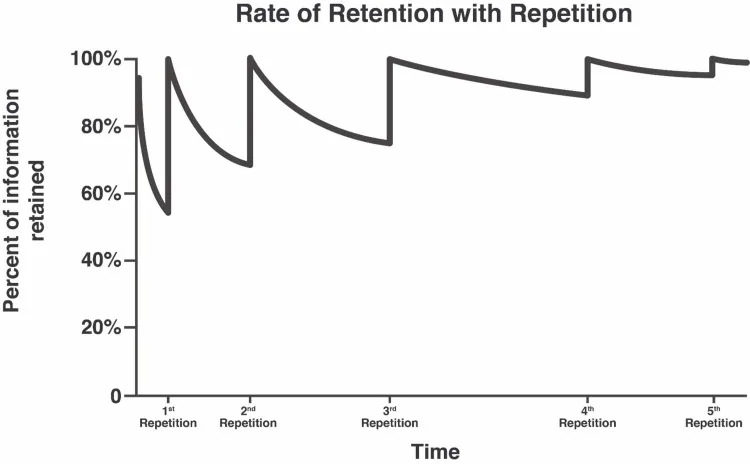
With easy accessibility and the capability to revisit lessons, learners can improve their retention percentage by repeating those previously completed microlearnings. The retention level can reach that of early levels or at least level off and avoid a downward curve. According to Kang 2016, hundreds of studies in cognitive and educational psychology have demonstrated that spacing out repeated encounters with the material over time produces superior long-term learning [3]. Figure 2 shows a hypothetical example of a memory retention curve affected by repetition over time.
Figure 1
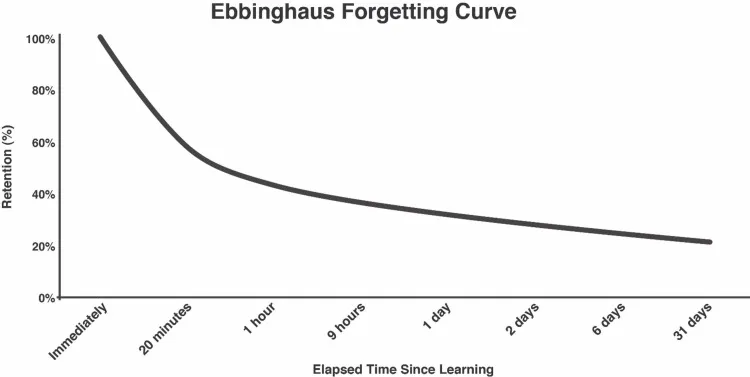
Figure 2
In a time defined by constant innovation and rapid changes, microlearning has emerged as an effective tool for learning and professional development. By delivering focused, accessible, and engaging learning experiences, microlearning empowers the learner and sets them up for knowledge retention. Embracing microlearning is not just a trend, it is a strategic necessity for success in our fast-paced and changing industry.
Explore HARDI's L&D Opportunities
HARDI courses continue to grow and evolve based on the needs of our members. The course library is available with individual, group, or custom subscriptions to our LMS called HEAT.U. For more information about our process or products, or to schedule a consultation, please contact us at Talent@hardinet.org and explore more of our learning paths.

Sarah Wilster
Instructional Designer
Sarah is an instructional designer with over 18 years of experience turning complex HVACR topics into clear, inclusive learning. At HARDI, she helps members tackle challenges like the IRA and A2L transition through training that actually connects and engages learners for optimal retention. Breaking down complexity is my superpower. Empowering our members is the mission.

You might be interested in...

HR & Training
Webinar Replay: Future Talent in HVACR: Distribution & manufacturing workforce for a digital era

HR & Training
Webinar Replay: The Rise of AI at Work: Opportunities, Regulations, and Responsible Practices

HR & Training